Posts

What exactly is Internet of Things (IoT)?

Image
If you think that the internet has changed your life, think again. The Internet of Things is about to change it all over again!” — Brendan O’Brien, CEO, Aria Systems. ——————————————————————————————————— Not every technology in the past has been able to seep into our lives seamlessly and create a huge impact on the way our lives work. But there are some technologies, that have been able to do it successfully. For example, technologies like smartphones, internet, iPad, Android systems have definitely changed our lifestyles. Another such technology that has integrated seamlessly into our lives is the Internet of Things(IoT). Let us understand- What is the  Internet of Things(IoT) ? IoT is a very simple concept. All devices connected to the internet is called the internet of things. A few years ago, only smartphones, PCs, laptops could be connected to the internet. But with IoT, many other devices can be connected to the internet too. However, just connecting to the int...

What is a data lake?

Today, the promise of big data to transform business outcomes is immense. Companies trust big data, to gain key insights and competitive advantage since big data create growth in new and unexpected ways. What is Big Data? Your data is simply data unless it is processed. Big data in simple words, is a large amount of data that has been stored in databases, cloud, and other file storage systems. Webopedia defines big data as a large volume of both structured and unstructured data sets that is difficult to process using traditional database and software techniques. This means that Big Data storage can be structured or unstructured. The collection of both structured and unstructured data in digital format is Big data. What is structured data? As the name suggests, this data storage follows a structure. The structure involves storing files in databases based on structured file formats (e.g. relational databases). This makes them very easy to search. Structured Query La...

What are Linux containers?

Image
In contrast to traditional applications where all components are developed in one piece, some types of applications become easier to build and maintain when they are broken down into smaller pieces that work synchronously. Applications that are built as modular components are easier to understand, test and maintain. Naturally, this makes your organization more agile. Organizations can benefit from time reduction, scalability, and resilience. So, what are  Linux Containers ? Linux Containers are a set of one or more processes that are isolated from the rest of the system. Simply put, Containers are software packaging applications that isolate only those components that are needed for its operation. Containers encapsulate software/service, application, all of its dependencies and a minimal amount of runtime applications that it needs to perform its function. Linux Containers  are therefore very similar to traditional Virtual Machines. But then, How are Linux...

What is disaster recovery, RPO and RTO?

Image
Let’s face the fact: Disasters occur. There can be floods, fires or cyclones. There can even be a cyber attack or a ransomware attack. Organizations can’t afford to be non-operational because of regional power outages, cyber attacks or hardware failures. Every minute applications and systems are down translated into lost revenue. 2015 disaster recovery statistics suggest that downtime lasting for one hour can cost small companies as much as $8,000, mid-size organizations $74,000, and large enterprises $700,000. As IT systems have become increasingly critical to the smooth operation of a company, and arguably the economy as a whole, the importance of ensuring the continued operation of those systems, and their rapid recovery, has increased. For example, of companies that had a major loss of business data, 43% never reopen and 29% close within two years. As a result, preparation for continuation or recovery of systems needs to be taken very seriously. You might not be ab...

What is SaaS?

Image
Most cloud computing service architectures fall into 3 broad categories: · Infrastructure – As-A-Service · Platform-As-A-Service · Software-As-A-Service Software as a service is a method of delivering software over the internet, on demand and typically on a subscription basis. With SaaS, cloud providers host and manage the software application and underlying  infrastructure  and handle any  maintenance  like software upgrades , users need not worry about. SaaS allows users to connect to and use cloud-based apps over the internet. Common examples include email, calendaring. The applications reside on remote cloud network accessed through web or API. How does  SaaS  Work? By means of what’s called multi tenant architecture, SaaS strictly delivers business software to thousands of customers. The cloud component simply implies an active connection to the internet and those devices and browsers that make access possible. All the elements t...

Cloud versus In House Data Center - What is better for your Business?

Choosing how your data center runs is very much like choosing a property to buy. The decision process to zero on one is huge and the costs involved are comparatively high. Each property has its own set of advantages, as well as some drawbacks. Yet, one option will be most suitable depending upon your requirements. In a similar manner, let's look at some factors that you should keep in mind before you chose an in-house data center versus cloud. What is an In-House Data Center? In -house   data center   is an on-premise IT Facility, fully managed by the company's IT Team. It is a space within the company and uses the organization's space, cooling, network, and resources. So when should you go for an in-house Data Center? Total Control of IT infrastructure An in-house IT Center is all under your control. For organizations that need frequent access to the data centers, this is the best option. Modification and addition to existing   IT infrastructure   are easier...

What is Hybrid Cloud ?

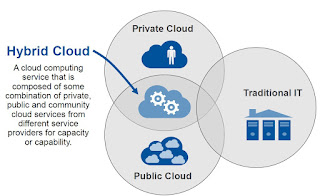
Image
Hybrid Cloud Hybrid cloud  combines public and private clouds. It allows companies to mix and match the facets of all the types of cloud to best suit their requirements. For example, a company can balance its workloads by locating mission-critical workloads on a secure private cloud and deploying less sensitive data on public one. It not only safeguards and controls strategically important assets but does so in the most cost- and resource effective way. The major benefits are: Improved  security and privacy Enhanced scalability Reasonable price The Major concerns are: Makes sense only if companies can segregate their data into mission-critical and non-sensitive